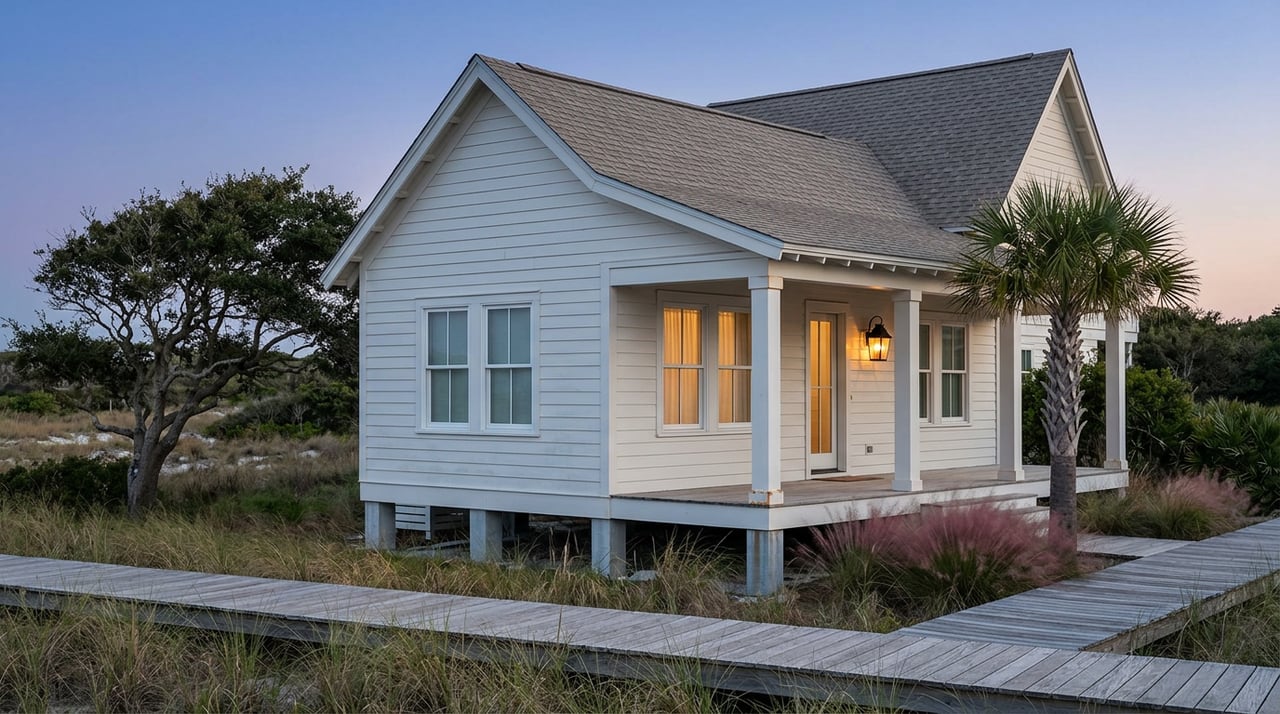
In Santa Rosa Beach, Two Identical-Looking Gulf-Front Listings Can Have Two Very Different Beaches
September 24, 2026
September 24, 2026
Walk the boardwalk at Ed Walline Regional Beach Access on a Saturday in July and you will see the split before you reach the sand. To one side, beachgoers are packed in rows, chairs and umbrellas edge to edge. To the other side, the sand opens up, wide and mostly empty, marked off by no-trespassing signs and a security guard standing under a red umbrella. Same beach. Same water. Two different rules, a few hundred feet apart.
That split is not a fluke of one busy weekend. It is the visible result of a legal fight that has been running in Walton County for a decade, and it matters more to a Santa Rosa Beach buyer than square footage or a Gulf view ever will. Two gulf-front homes can list at nearly the same price, with nearly the same layout, and deliver two completely different ownership experiences: one where the dry sand in front of the house functions as an open public beach, and one where it does not. The difference is not something you can see in listing photos. It is something you have to ask about, parcel by parcel, before you write an offer.
According to Get The Coast, Walton County adopted a customary-use ordinance in October 2016. Two years later, the Florida legislature passed a law that exempted any local customary-use ordinance adopted before January 2016 from a new, harder legal standard. Walton County's ordinance missed that cutoff by nine months. That cutoff mattered in Walton County.
According to Live News Chat, the county ended up litigating and settling with owners across more than a thousand individual gulf-front parcels rather than trying each one separately. According to Visit South Walton, a 2023 settlement agreement created what officials call a Transitory Zone on the specific private beaches covered by that agreement: public access is allowed up to 20 feet landward of the wet-sand line. That zone only applies to the parcels named in the settlement. Everywhere else along the 26 miles of Walton County shoreline, the situation varies from stretch to stretch.
In 2025, the Florida Senate voted 35 to 2 to repeal the 2018 law, on a bill sponsored by Sen. Jay Trumbull that Governor DeSantis later signed. On paper, that handed Walton County the authority to pass a new customary-use ordinance the moment the ink dried.
Here is the part a buyer needs to sit with: authority to act is not the same as acting. According to SoWal, on May 26, 2026, the county commission passed a resolution, not an ordinance, affirming support for public beach use and thanking Dune Allen, Inc., for voluntarily sharing its beach with non-owners. A resolution states a position.
That distinction is why NPR's reporting from Santa Rosa Beach this September still describes the same standoff that existed before the repeal: no-trespassing signs, hired security, and beachgoers left to guess where they can legally set up a chair. One local restaurateur and beach access advocate put it this way in NPR's report: "What we're fighting for is the right for people to go to a public access and walk as far as they want with their beach chairs and set up on any beach." Homeowners on the other side of the line see it differently, arguing that unrestricted access ignores property rights they consider settled by deed.
| What it does | What changes for a gulf-front parcel | |
|---|---|---|
| Resolution (passed May 2026) | States the county's position | |
| 2023 Settlement | Agreement with specific owners | Transitory Zone applies only to named parcels |
| Quiet-title judgment | Court ruling on a specific property | Stands regardless of any later state law change |
None of this is theoretical for someone actually renting a beach chair. Walton County Tourism still maintains 58 public beach access points, including nine regional accesses with parking and restrooms, and the wet sand along the entire shoreline remains open to everyone for walking. What changes house to house is the dry sand in front of a private home, the part where a family actually sets up for the day. On one lot, that strip might fall inside a 2023 settlement and carry a defined 20-foot public zone. On the next lot, it might carry a quiet-title judgment. On a third, nothing has ever been litigated.
A homeowner described the pressure from the other direction: crowded public accesses pushing overflow onto private lots, sometimes well past a folding chair. They have installed cameras and called the sheriff over people setting up under their house. That is not a hypothetical inconvenience. It shapes how a property actually gets used, insured, and enjoyed, year over year.
If you are comparing gulf-front homes in Santa Rosa Beach right now, the sale price will not tell you which situation you are buying into. The parcel's litigation history will. Before you get attached to a specific lot, it is worth asking:
These are not questions a listing sheet answers. They are the kind of contract-stage due diligence that separates a smooth closing from a surprise six months later, when a neighbor's guard turns away a guest or a title search turns up a judgment nobody mentioned during showings. A legal background in contract review exists precisely for moments like this, where the paperwork behind a property matters as much as the property itself.
Does owning gulf-front property in Santa Rosa Beach guarantee a private beach? Not automatically, and not uniformly. It depends on whether that specific parcel was part of the 2023 settlement, whether a quiet-title judgment exists, and whether the county eventually passes a new ordinance. Each of those is parcel-specific, not neighborhood-wide.
Can I find out a parcel's settlement or litigation status before I make an offer? Yes. The county's beach operations office and the county attorney's office both field questions on specific properties, and title work during due diligence should surface any recorded judgment. Asking early, rather than after an offer is accepted, gives you time to weigh what you're actually buying.
Does this affect every Walton County beach, or just certain stretches? Public beaches and state parks like Grayton Beach State Park and Topsail Hill Preserve are unaffected. This entire question only applies to privately owned dry sand in front of gulf-front homes, which is a smaller and more specific category than "beachfront" as a marketing term suggests.
Santa Rosa Beach rewards buyers who ask the right question at the right moment, not just the ones who fall for the view. If you are comparing gulf-front parcels here and want someone who will actually run down a property's settlement and title history before you write an offer, 30AMY HOMES is built for exactly that conversation. Schedule a Personal Consultation and let's look at the specific parcels you're considering, not just the price per square foot.
This article is general information, not legal, tax or financial advice. Consult a qualified professional about your situation.
Stay up to date on the latest real estate trends.
Whether you are buying or selling, you will find Amy's attention to detail, fun personality, and client-centered approach invaluable. Amy makes the real estate transaction seamless and handles all aspects of the transaction with integrity and professionalism.